5 Peer Editing Strategies That Actually Work For Student Writers
When you ask your students to do peer review of their writing, do they stare at you with puzzled expressions? Here are five specific, hands-on approaches to peer conferencing that your students tin can really sink their teeth into.
Revising and editing a peer'south writing helps students larn to work equally a team. It too gives them a fresh perspective on the proofreading procedure that will assist them become more aware as they write and edit their ain work. So, how can yous make the peer review and editing process engaging, meaningful and fun for students? Hither are five ways to go your students excited about peer review that actually piece of work!
- Neon Revision
 Many kids don't know what or where to marker when reading some other student'south piece of work. Neon revision is an approach that can really aid. Starting time, give each student or pair of students three highlighters and these instructions:
 Highlighter Markers: 3 Colors
Yellow – Mark the beginning give-and-take of each sentence. Questions to call back most: Is there variety? Does the writer use transitional words? Are there whatsoever sentence fragments or run-ons?
Pink – Highlight each adjective. Think about: Is the writing descriptive? Are the adjectives strong and specific?
Blue – Highlight each verb. Think about: Are there besides many "to be" verbs? Are the verb choices strong?Students begin by highlighting specifics. Then, remind them to wait at the big motion picture. Subsequently highlighting, they tin can make comparisons and add suggestions about what the student needs to add, suit or remove. Proofreading volition come later. First, they are helping a peer with sentence fluency and word selection—both descriptive language and "showing without telling."
Teach students about the revision sandwich: compliment, propose, correct. Remind students that when reviewing someone's work, always start out by saying what they like about their work. Side by side, they make a suggestion and converse with their partner. Students ask questions. And so, they brand corrections. Past working together, they both learn from each other.
- Writing Wheel Checklist
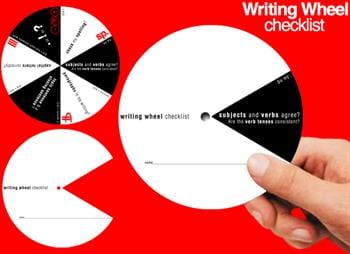 Have students assemble their writing wheels using this template, a piece of plain paper and a brad for the heart. To assemble, cut out both circles and attach with the brad. Explain that they will use the writing cycle checklist to aid them edit one another's writing. Students should practise each task on the bike as they review another's work. The writing bike checklist is portable, and so students could even check their peers' writing from domicile on a class blog! Students can mail their writing on a kid-friendly blogging site such every bit Kidblog or Weebly, where peers tin can write comments. Using their writing cycle as a reference, students volition know how to assess their classmates' compositions for conventions.
 Click hither for a PDF of the Writing Wheel Checklist.
- Revising vs. Editing (What'due south the Difference?)
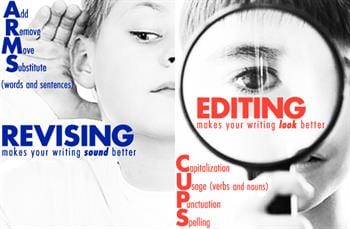 Students need to know the difference between revising and editing in order to aid refine their peers' writing. Revising makes writing better. Editing makes writing correct. A popular arroyo in many classrooms is to use the acronyms ARMS (for revising) and CUPS (for editing).
 Revising (The big picture show)
Add words and sentences (exist descriptive, capture all ideas).
Remove words and sentences (be concise).
One thousandove words and sentences (sentence fluency, organization).
Substitute words and sentences (give-and-take choice, vocalism).Editing (Conventions)
Capitalization
Usage (Verbs and nouns—does it brand sense?)
Punctuation
SpellingTo assist students with their understanding, say you lot utilize your arms and mitt to hold your ear to help them retrieve that when you revise, you want the writing to audio improve. If yous punch a hole in a cup and look through it, y'all are using your eyes. This will assist them recollect that when you edit, you lot want your writing to look amend. Students could even create a telescope made out of a newspaper cup and call information technology their Revisoscope! Check out Decorated Bee Kids Crafts to see how to construct ane. Once students know the departure between revising and editing and accept the acronyms memorized, they can jot them down on a Post-it annotation when checking a peer's writing. The acronyms volition remind students of what to expect for and how writing tin can exist improved to brand it look and sound ameliorate!
- Proofreading Spectacles
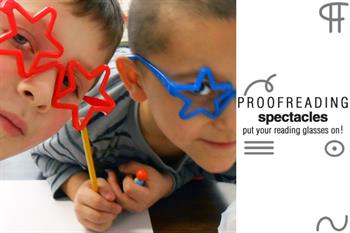 Put your proofreading spectacles on, it's time to edit! To make editing for conventions fun, have students wear crazy glasses with the lenses popped out of them. It will motivate students and encourage them to look closely at their peers' writing. Remind students to always reread to check for misunderstandings in writing. You tin can purchase glasses at the dollar store or a party supply store. You could besides have students create their own glasses out of paper.
 - Switch! Revising and Editing Stations

Set upwardly six stations around the room. Characterization each station with ane of the following titles:
i. Give-and-take Pick
2. Ideas and Content
3. Organization
four. Sentence Fluency
five. Voice
vi. ConventionsPrint out Be the Editor task cards for students to utilise when revising and editing at each station. Students use Zaner-Bloser's task cards to help them discuss and check one some other's writing! The task cards provide the children with prompts, making editing/revising easier. By concentrating on one writing trait at a time at each station, students will not feel overwhelmed. Forth with the task cards, put out highlighters, viscous notes, colored pencils and other writing utensils to keep students interested.
hurleywastive2002.blogspot.com
Source: https://www.weareteachers.com/5-peer-conferencing-strategies-that-actually-work/
0 Response to "5 Peer Editing Strategies That Actually Work For Student Writers"
Post a Comment